Bud Harris
American RustBud Harris is Buell’s police chief, a public official working in a town where shrinking resources and personal ties make the exercise of authority unusually intimate. His choices around Billy Poe’s case are not simply a matter of enforcing rules or ignoring them: they reveal how Harris understands responsibility in a community where he knows the people whose lives his decisions can change. His care for Billy, his unresolved history with Grace Poe, and his later confrontation with Murray Clark pull that local ethic toward a dangerous limit.
Identity and Background
Harris has been chief of police for ten years. He is careful to distinguish his position from the authority of a chief in a larger city: Buell has only six full-time officers, and financial crises threaten the department with further layoffs. The title gives Harris responsibility, but not the personnel or stable institutions that might make responsibility easier to discharge.
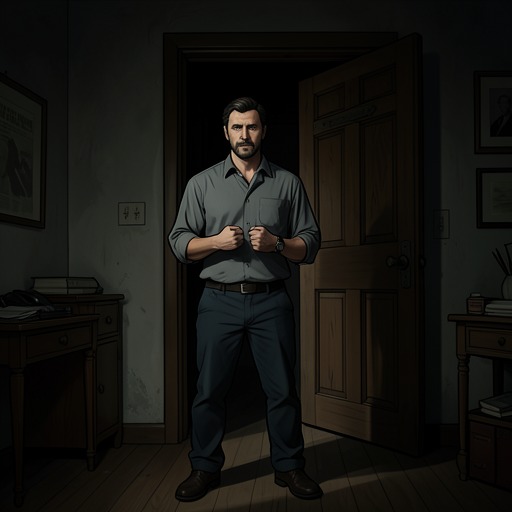
He is more than fifty, yet Grace notices that he moves with the energy of a much younger man when he arrives in his tall truck. His private life is less settled. He lives in a cabin on a mountain that, in his own judgment, no woman in her right mind would choose. His inner figure of Even Keel represents the self-command he tries to maintain, but Harris also recognizes that this ideal can become a hiding place for fear and inaction.
Buell’s Decline and the Limits of the Badge
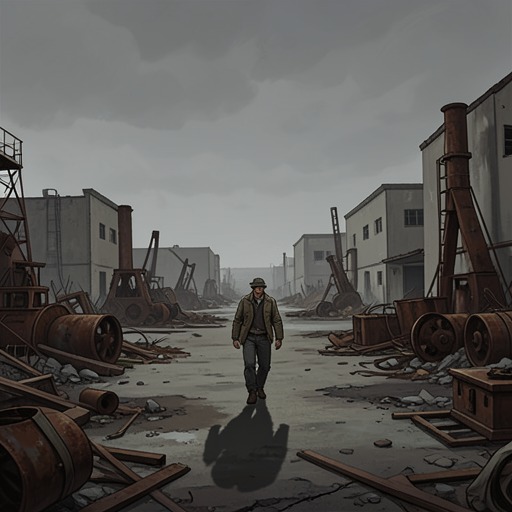
Harris’s work unfolds against the Mon Valley’s long economic contraction. The region had once been a global center of steel production, but by the time Isaac English and Billy Poe were growing up, it had lost 150,000 jobs. Many towns could no longer afford basic services, and some had lost their police. In Buell, falling incomes and shrinking budgets coexist with growing population, deteriorating infrastructure, and problems more commonly associated with larger cities. Young people face few prospects, while the kinds of office jobs that require college are too scarce to answer the need.
The department’s own budget makes that decline concrete. After the city council reduces its allocation from $785,000 to $541,000, Harris expects to cut training, keep already worn-out vehicles in service, and lay off three full-time officers—nearly everyone in a six-person department. The sewer system’s pollution of the Mon during heavy storms is another municipal problem requiring money the city does not have. Harris’s decisions therefore take place in an institution weakened not only by personal loyalties but also by the material limits of local government.
Grace’s memories show how those pressures reach into family life. She met Virgil Poe while working on the rolling line, married him after becoming pregnant, and continued her education while raising a child. She was close to completing an associate degree when layoffs came; Virgil, after surviving several rounds, lost his job despite having five years of seniority. Their trailer went into foreclosure. Pickets at sheriff’s sales, armed residents, and the burning of a banker’s Cadillac helped prompt a judicial moratorium that eventually became law. The family kept the trailer, but lived on food-bank supplies and poached deer. Harris’s professional world is inseparable from this history of lost work, precarious housing, and improvised community protection.
Discretion and Billy Poe
Harris’s attachment to Billy is tested when he hides a jacket belonging to him. The garment remains undiscovered while Harris sits with Steve Ho, and Harris is troubled less by the concealment itself than by what it means to protect Billy. He frames policing as a set of judgments made in context: not every minor offense requires arrest, and a young person may deserve more latitude than an adult. In his view, the community has an unwritten expectation that people should do right, but applying that expectation can mean either intervening or allowing someone another chance.
His conscience supplies opposing arguments. Even Keel urges him to get out of the truck, find the jacket, and arrest Billy; Harris calls that inner voice cowardly and decides to wait and see which part of himself is right. When he spots Billy and a shorter friend returning toward the meadow, apparently to retrieve the jacket, he thinks of Grace and feels sick. His observation brings the private stakes of his decision into immediate focus: he knows whose property is hidden and whose family may suffer if the case advances.
Harris nevertheless takes Billy into custody and places him in the worst cell overnight, intending that the experience make clear what may lie ahead. He suspects that developments in the district attorney’s office will not favor Billy. When Grace calls, he answers cautiously that Billy had been spending time in places he should have avoided; her manner leaves him with the impression that she knows what her son has done. Harris tells her he is trying to help and will do what he can.
That promise becomes practical rather than merely reassuring. After paperwork, Harris brings Billy out of his cell, interpreting the boy’s depressed appearance as a good sign. He lets him go home for the night, ostensibly so he can get himself in order, and says he will come to collect him before the state police do. He tells Billy to make his shoes and any box or receipts disappear, while warning him not to run because flight would make the outcome worse. The episode captures the contradiction in Harris’s role: he is directing a suspect to remove evidence even as he keeps him within reach of the authorities.
Grace Poe and Private Loyalty
Harris and Grace have been involved on and off for years. She nearly left Virgil for him twice, but ultimately could not imagine a life with the quiet, awkward Harris. She has dated many other men and remained with Virgil, yet still finds herself thinking about Harris. Her uncertainty about whether she used him is itself part of their history: affection is present, but it has never resolved into a shared life.
The connection continues to influence how Harris responds to her. When he arrives at Grace’s house, his movement from the truck is a comfort to her. Later, he finds her sitting on the couch in a way that makes him wonder whether something is wrong; for a moment he considers whether Virgil has returned, then thinks she may be drunk. His perceptions are not detached observations. Concern for Grace repeatedly enters his assessment of Billy’s case, making the boundary between police judgment and personal loyalty difficult to maintain.
Murray Clark and the Limits of Protection
After leaving Grace’s house, Harris goes directly to the station and considers whether Billy might be better off standing trial. Murray Clark, he reasons, is a drunk and might not appear persuasive to a jury; but if anything happens to Murray, the district attorney will search aggressively for an explanation. Harris’s calculation recognizes both the possibility of a legal defense and the danger of trying to control the case by intervening personally.
He retrieves a five-shot revolver from the evidence room. Its tag dates it to 1974, and the old boxes around it have accumulated through a station move. Harris thinks of Grace while examining the weapon, then drives toward one of the addresses Murray had supplied. In Brownsville, he studies a map book, memorizes the addresses without marking them, gets breakfast, and fills both of his truck’s fuel tanks in case he needs to travel a long way. At the first address, he moves through an overgrown yard and enters a house where an elderly woman lies on a narrow bed beside an oxygen tank. He puts the gun away. The encounter interrupts any simple assumption that the address, and the people found there, can be reduced to a target in his plan.
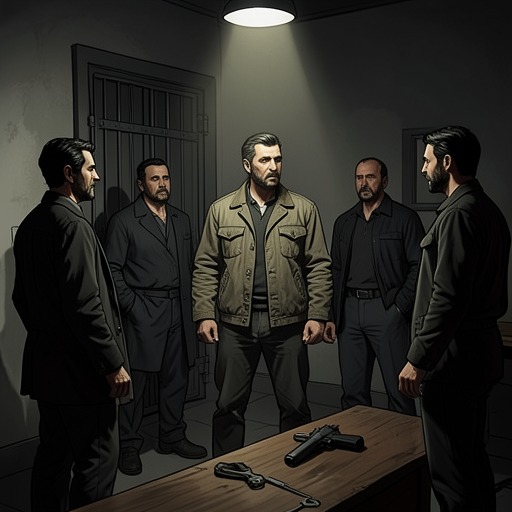
At a later address, Harris points the revolver at Murray, who raises his hands. The supplied scene establishes the confrontation but does not, on its own, make the result of that moment a matter of description. Later, Isaac English finds Harris alone in an unusual room at the station, with wood-and-leather furniture and paintings unlike the building’s cinderblock walls and fluorescent lights. Harris is pale and disheveled, a blanket around his shoulders and one hand secured in a splint. He tells Isaac that Billy was charged with killing a man but now appears likely to be released; Isaac, Harris explains, has not been identified, and Billy has not given him up. Harris says he will contact Billy’s lawyer when their conversation is over.
Narrative Role and Significance
Harris’s story makes small-town policing a question of judgment under pressure. He has formal authority, but few resources; he believes in a community obligation to do right, but the meaning of that obligation shifts when the person at risk is Billy, the son of the woman he still loves. His choices range from concealment and leniency to armed confrontation, with consequences that reach beyond the police station and into the lives of Grace, Billy, Murray, and Isaac.
The novel also places Harris’s decisions within a wider social collapse rather than presenting them as isolated personal failings. The town’s depleted services, threatened police layoffs, shuttered industrial prospects, and precarious households form the conditions in which informal codes take on practical force. Harris tries to act as protector and officer at once, but those roles do not always align. His uneasy version of Even Keel cannot make the conflict disappear; it only gives him another way to name the struggle over what he should do.